
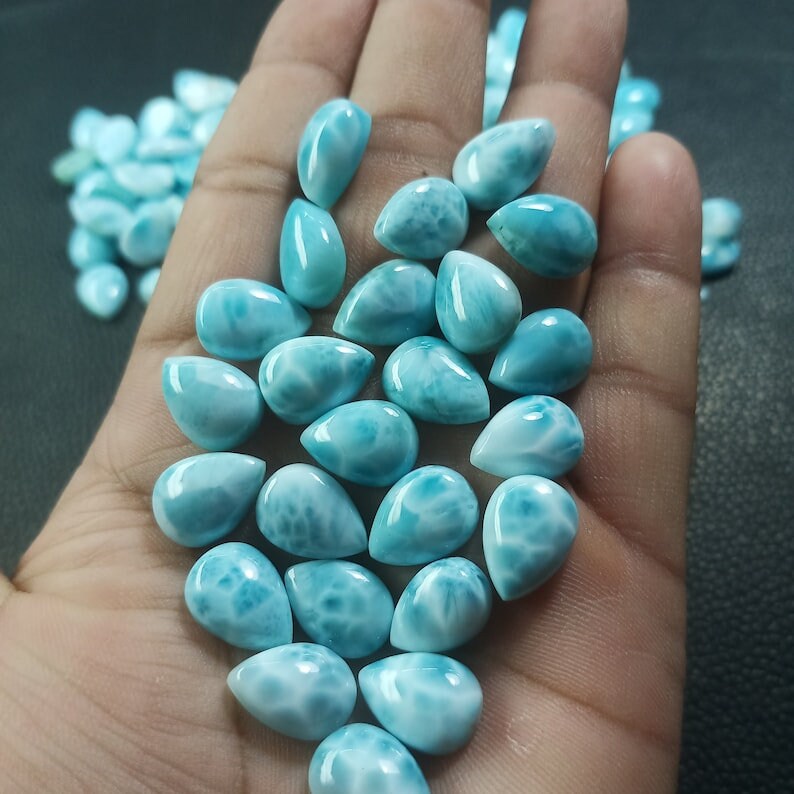
What is Larimar?
Larimar is a rare blue variety of pectolite, a mineral found in many parts of the world — but the gem-quality blue variety exists in only one place on Earth: the Dominican Republic. Formed through volcanic activity millions of years ago, Larimar is found deep within the mountains of Barahona province, making it one of the rarest gemstones ever discovered. Its striking color comes from the presence of copper within the stone, which replaces calcium in its natural crystalline structure and produces those stunning shades of blue, turquoise, and white that make it instantly recognizable.
A Stone With a Story
Larimar has a history as rich and fascinating as its appearance. The stone was officially rediscovered in 1974 by a Dominican officer named Miguel Méndez and Peace Corps volunteer Norman Rilling, who found it washed up along the shoreline. Méndez named the stone by combining his daughter’s name, Larissa, with the Spanish word for sea, “mar” — giving us the poetic name we know today: Larimar.
However, the story of Larimar goes back much further than 1974. As early as 1916, a Spanish priest named Father Miguel Domingo Fuertes Loren requested permission to explore and mine a blue stone he had discovered in the region. His request was denied, and the stone remained largely unknown to the outside world for decades. Indigenous Taíno people, however, had known about it long before any of this — they believed Larimar came from the sea itself, and some healers considered it a powerful stone of peace, healing, and clarity.
Even today, Larimar carries with it a sense of mysticism and legend. Many people refer to it as the “Atlantis Stone,” a name rooted in the writings of the famous psychic Edgar Cayce, who predicted that part of the lost continent of Atlantis would be found in the Caribbean. Whether you believe in its mystical origins or simply appreciate it as a stunning natural gemstone, there is no denying that Larimar carries a sense of wonder that few other stones can match
Colors and Quality
Larimar comes in a beautiful range of colors, from pale white-blue and soft sky blue to vivid turquoise and deep volcanic blue. As a general rule, the deeper and more saturated the blue color, the more valuable the stone. The most prized specimens display a rich, intense blue with minimal white patterning and no brown or red undertones — these are considered collector grade and are becoming increasingly rare as the mines produce less high-quality material each year.
The white patterns within Larimar, often described as resembling clouds, waves, or sunlight on water, are part of what gives the stone its unique character. Some collectors actively seek out stones with particularly artistic or dramatic patterning, making each piece a miniature work of natural art. The presence of red or brown hematite inclusions, while natural, is generally considered less desirable and reduces the value of the stone.
Physical Properties
On the Mohs scale of hardness, Larimar ranks between 4.5 and 5, which places it on the softer end of the gemstone spectrum. This means it requires a little more care than harder stones like sapphire or diamond, but it is absolutely suitable for jewelry when handled thoughtfully. It is best used in pendants, earrings, and brooches where it is less exposed to daily wear and impact. If used in rings or bracelets, a protective setting is recommended.
Larimar has a triclinic crystal structure and a silky to waxy luster when polished. It takes beautifully to cabochon cutting, which is the most popular form for this stone as it best showcases the flowing patterns and depth of color within each piece. Faceted Larimar is less common but stunning when done well.Physical Properties
On the Mohs scale of hardness, Larimar ranks between 4.5 and 5, which places it on the softer end of the gemstone spectrum. This means it requires a little more care than harder stones like sapphire or diamond, but it is absolutely suitable for jewelry when handled thoughtfully. It is best used in pendants, earrings, and brooches where it is less exposed to daily wear and impact. If used in rings or bracelets, a protective setting is recommended.
Larimar has a triclinic crystal structure and a silky to waxy luster when polished. It takes beautifully to cabochon cutting, which is the most popular form for this stone as it best showcases the flowing patterns and depth of color within each piece. Faceted Larimar is less common but stunning when done well.
A Rare Treasure Worth Owning
With Larimar mines in the Dominican Republic producing less and less material each passing year, gemologists, collectors, and investors alike agree — this is a stone whose rarity and value will only increase over time. The single-source nature of Larimar means that once the deposits are exhausted, there will simply be no more. That makes every piece of genuine Larimar not just a beautiful gemstone, but a genuine piece of natural history.
Whether you are a jewelry designer searching for something truly extraordinary to set your work apart, a crystal enthusiast drawn to its calming oceanic energy, or a collector with an eye for rare and appreciating natural treasures — Larimar deserves a place in your collection. It is not just a gemstone. It is a piece of the ocean, a fragment of volcanic history, and one of the most beautiful things nature has ever created.A Rare Treasure Worth Owning
With Larimar mines in the Dominican Republic producing less and less material each passing year, gemologists, collectors, and investors alike agree — this is a stone whose rarity and value will only increase over time. The single-source nature of Larimar means that once the deposits are exhausted, there will simply be no more. That makes every piece of genuine Larimar not just a beautiful gemstone, but a genuine piece of natural history.
Whether you are a jewelry designer searching for something truly extraordinary to set your work apart, a crystal enthusiast drawn to its calming oceanic energy, or a collector with an eye for rare and appreciating natural treasures — Larimar deserves a place in your collection. It is not just a gemstone. It is a piece of the ocean, a fragment of volcanic history, and one of the most beautiful things nature has ever created.